News
AI Art Magazine – Interview (September 2026)
September 1, 2026
Alexandros Haridis: Beyond Data-Driven Aesthetics | An interview by Simone Brauner
Aesthetic judgment is one of philosophy’s oldest problems and one of computation’s newest. From Baumgarten’s 18th century aesthetica to Kant’s separate faculty of judgment, thinkers have long treated evaluation as a form of intelligence, distinct from beauty itself. The 20th century added a new question: could that faculty be modeled, formalized, even computed?
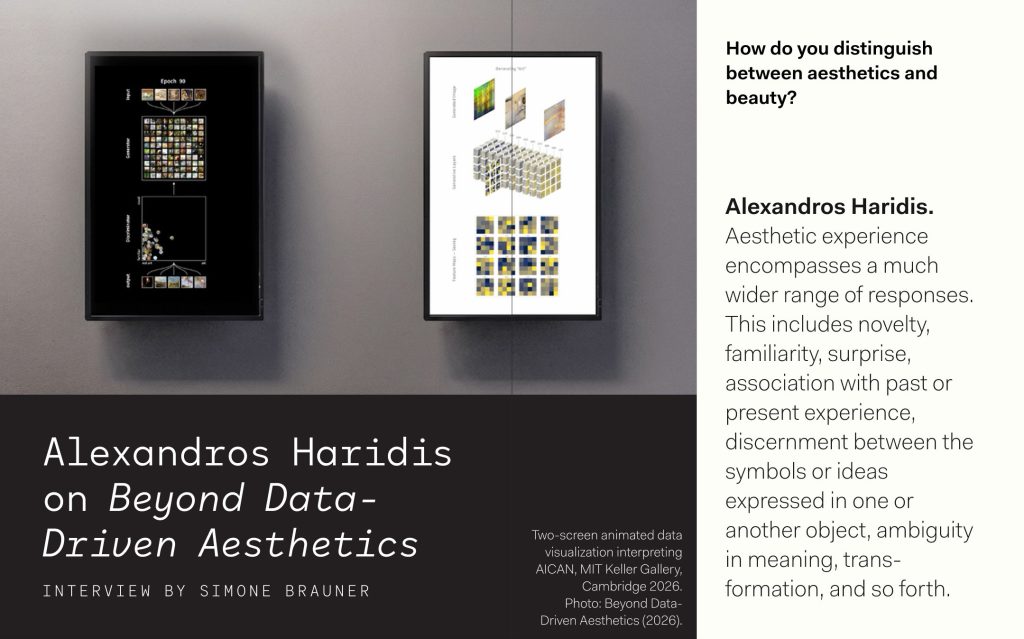
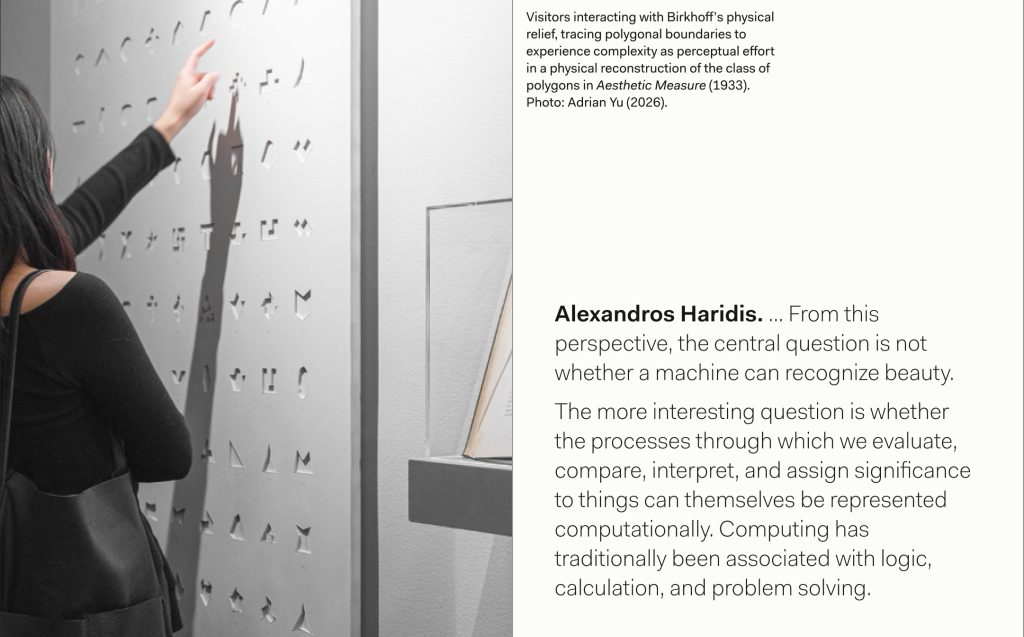
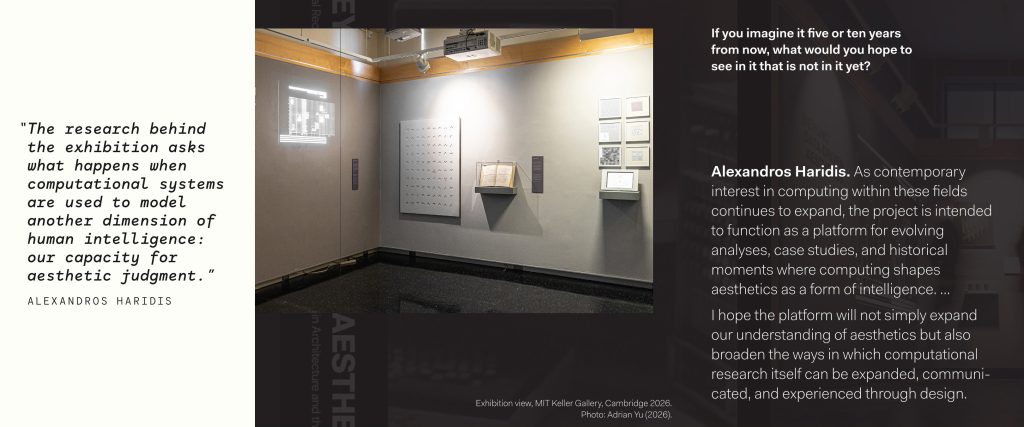
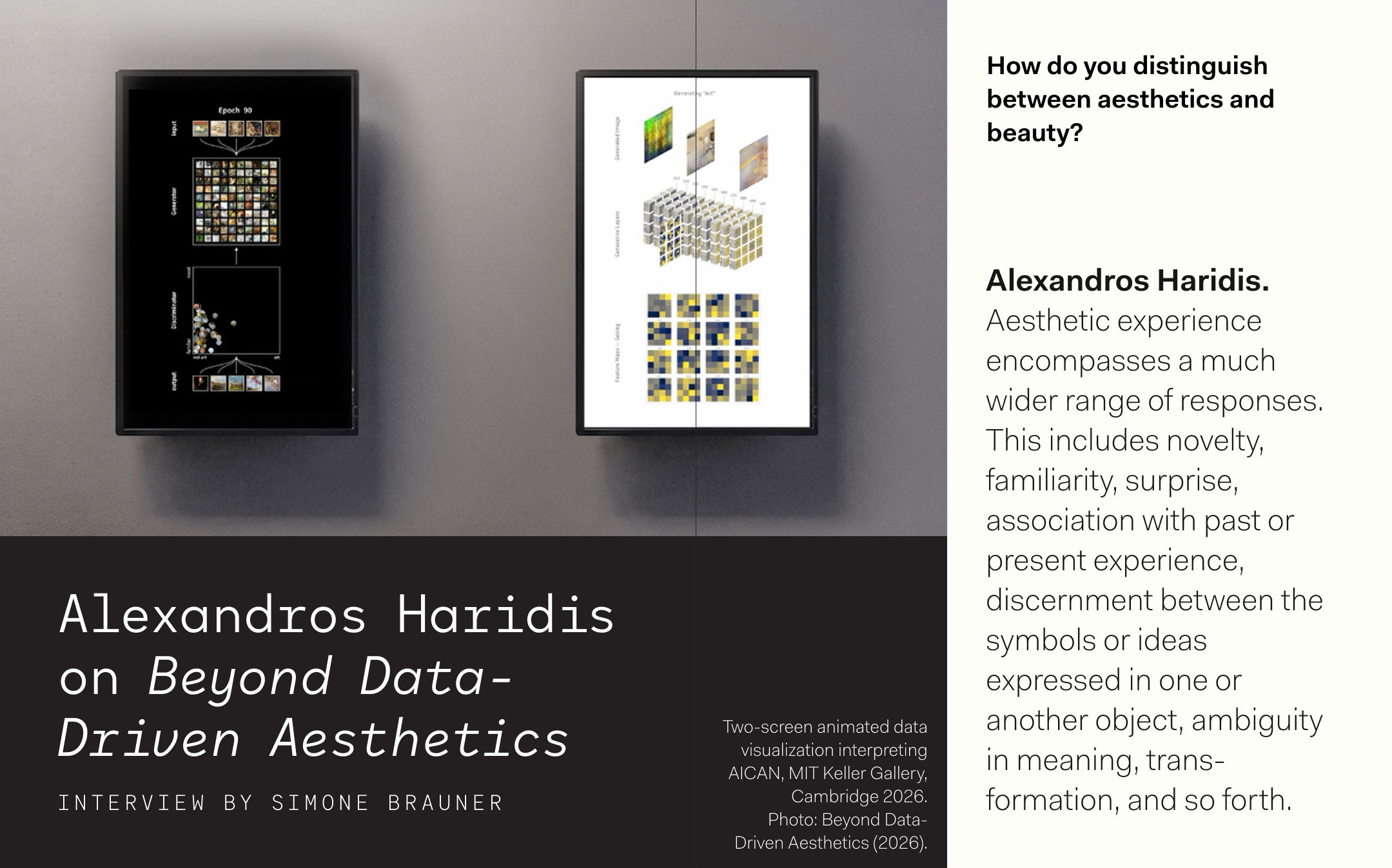
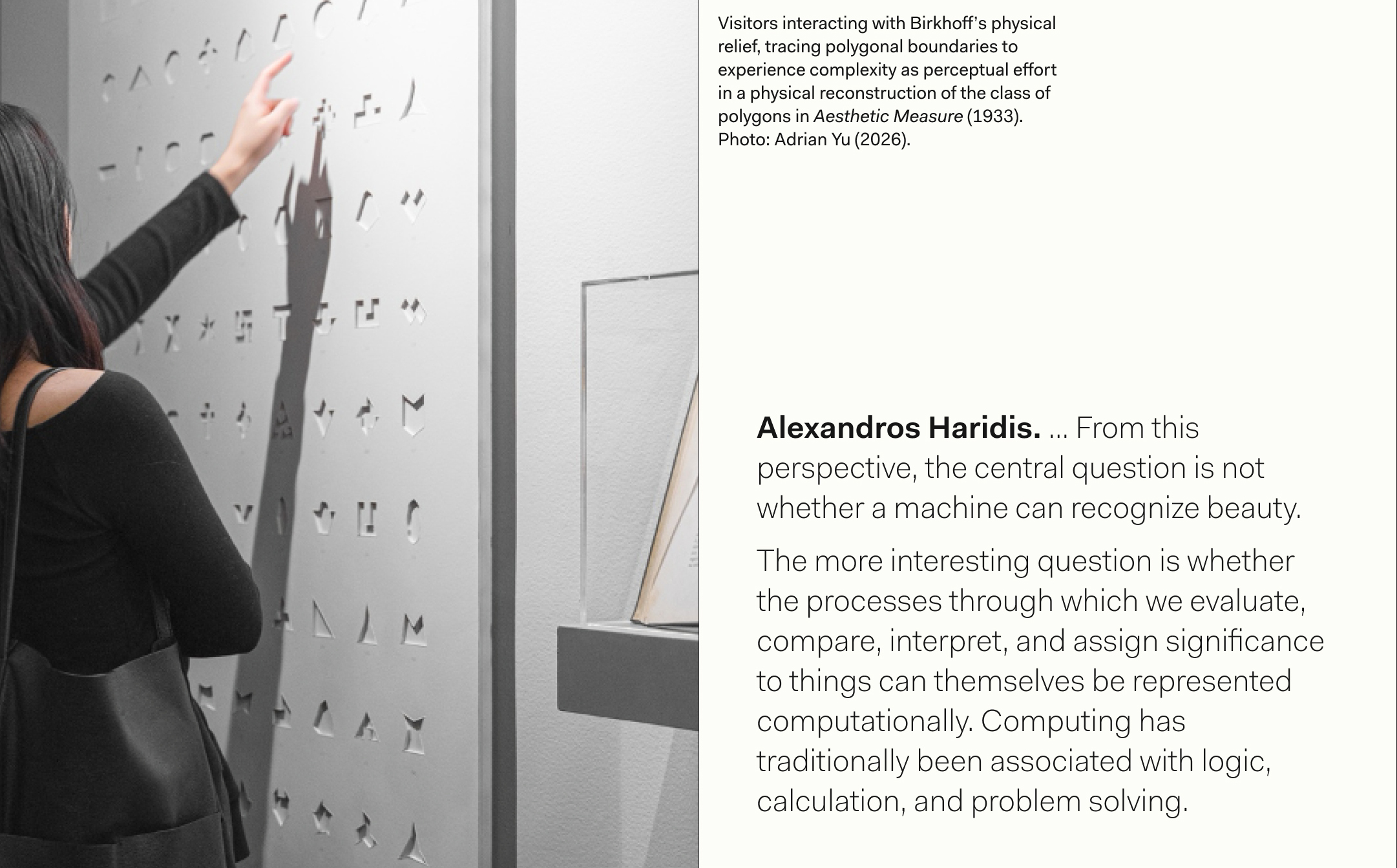
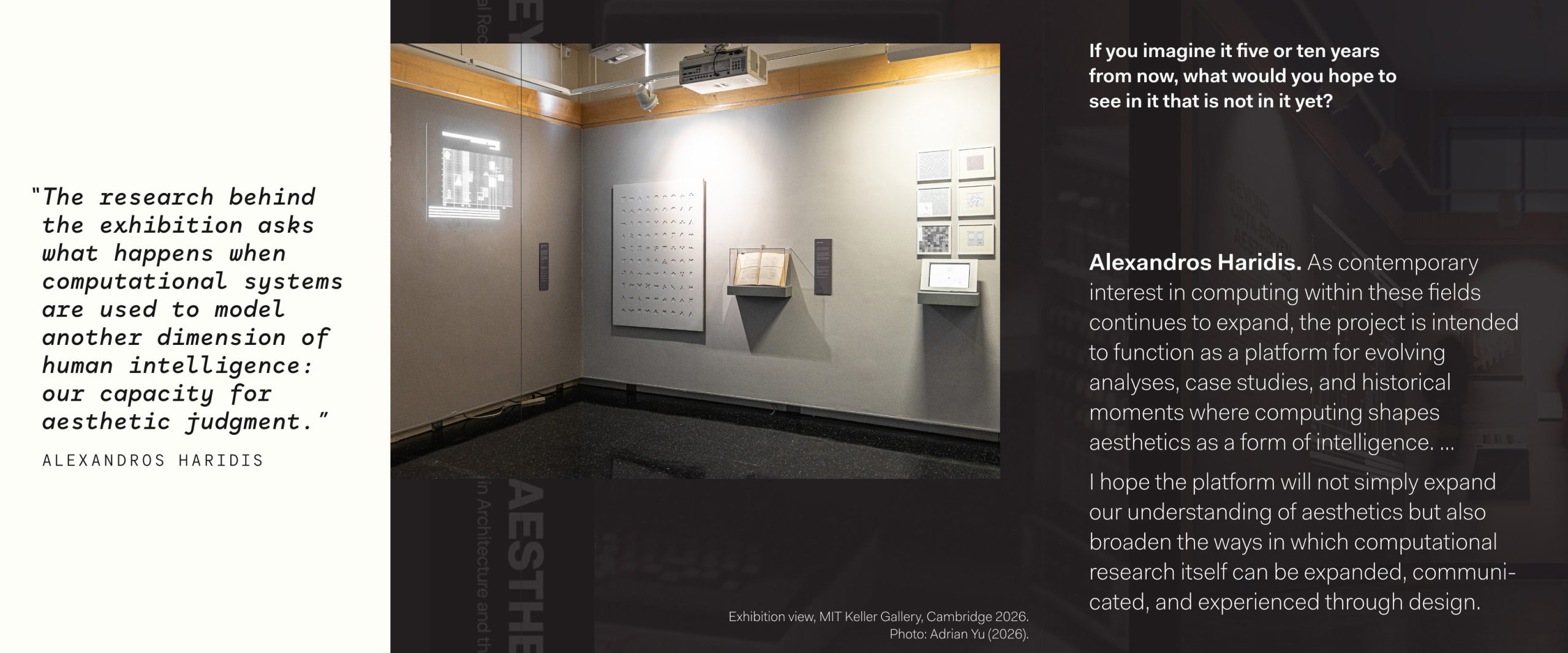
Alexandros Haridis has followed that question for four years. His exhibition Beyond Data-Driven Aesthetics presents five systems that tried exactly this: George D. Birkhoff’s 1933 formula, Vera Molnár’s guidelines, George Stiny and James Gips’s algorithm, Lillian F. Schwartz’s repurposed software, and AICAN, a generative network from 2017. In the gallery, they return as physical objects: a wall relief, acrylic panels, a tablet application, and video monitors.
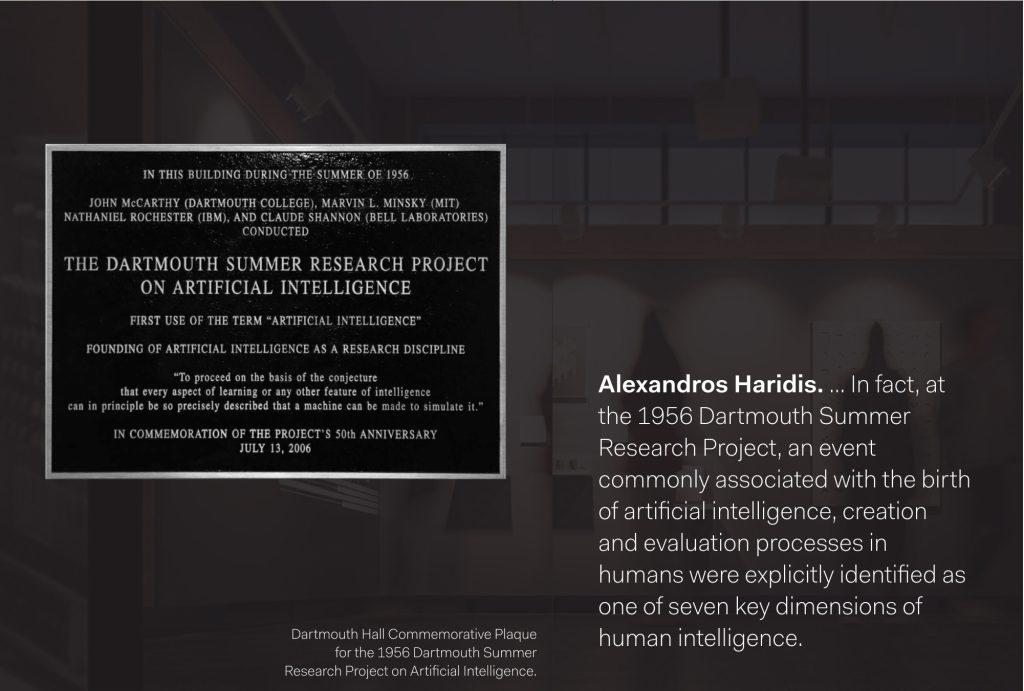
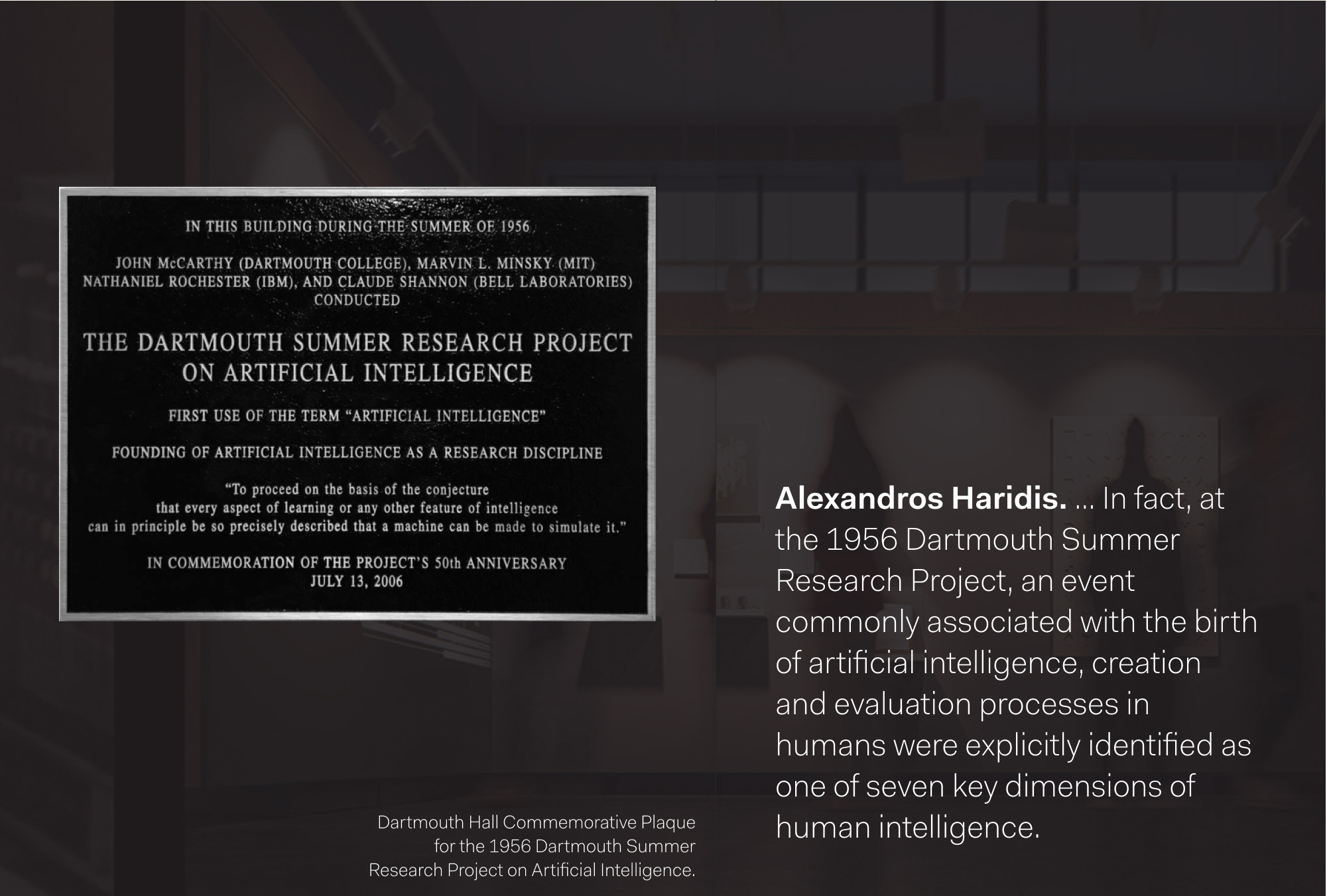
His starting point is a sentence from the 1956 Dartmouth Summer Research Project, where creation and evaluation were named among seven dimensions of human intelligence. Seventy years later, as he writes, that question has gained new urgency, one this conversation sets out to unpack.
Featured on the AI Art Magazine, on September 1, 2026.
Excerpt
Simone Brauner. You describe Beyond Data-Driven Aesthetics as both an exhibition and a research platform. The exhibition closes a chapter that begins in 1933 with Birkhoff and ends, for now, with AICAN. But the platform is open and ongoing. If you imagine it five or ten years from now, what would you hope to see in it that is not in it yet? A new system, a different question, a shift in method, a new voice to join?
Alexandros Haridis. “Beyond Data-Driven Aesthetics” is both a research exhibition and an ongoing platform for investigating how computational systems participate in processes of aesthetic judgment, generation, and transformation across architecture and the applied arts. As contemporary interest in computing within these fields continues to expand, the project is intended to function as a platform for evolving analyses, case studies, and historical moments where computing shapes aesthetics as a form of intelligence.
One of the central questions of the exhibition—and one that researchers across architecture, design, and engineering are increasingly focusing on—is computational evaluation beyond purely performative or functional requirements. This applies to many different design spaces, whether buildings, structural forms, or everyday products. Part of the reason is the growing effort to automate design through generative systems capable of producing innumerable options to choose from, yet we’re often left struggling with encoding decisions that involve aspects of design we often think of as exclusively human–things like aesthetic interpretation, discernment, and creative insight. I’ve become increasingly convinced that understanding these issues requires more than data alone. The exhibition’s case studies suggest that many of these questions long predate current interest in computing and AI and have been approached through a range of computational and theoretical models of evaluation since at least the early 20th century.
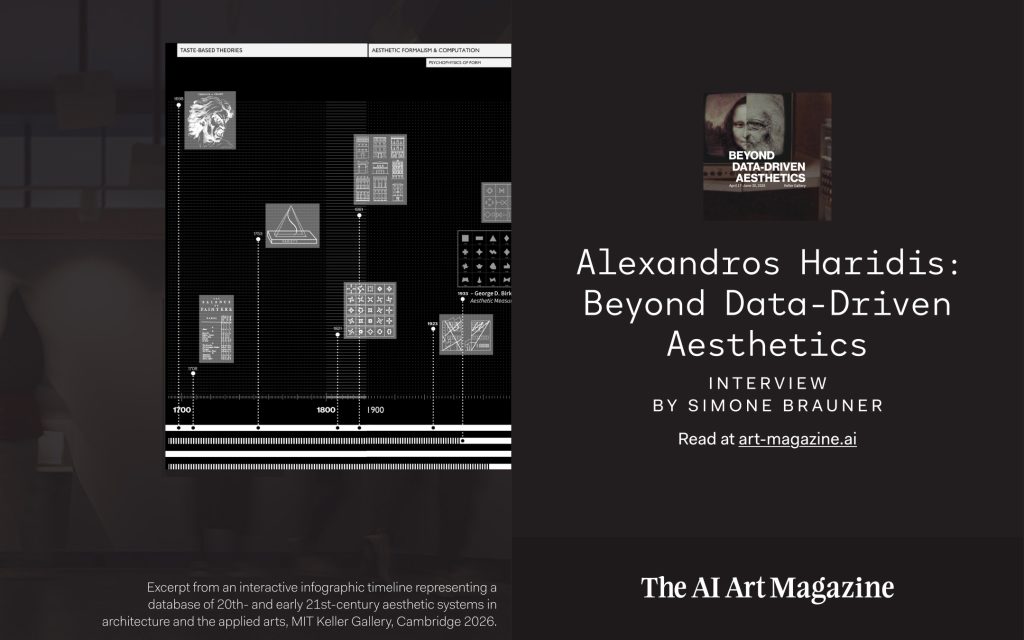
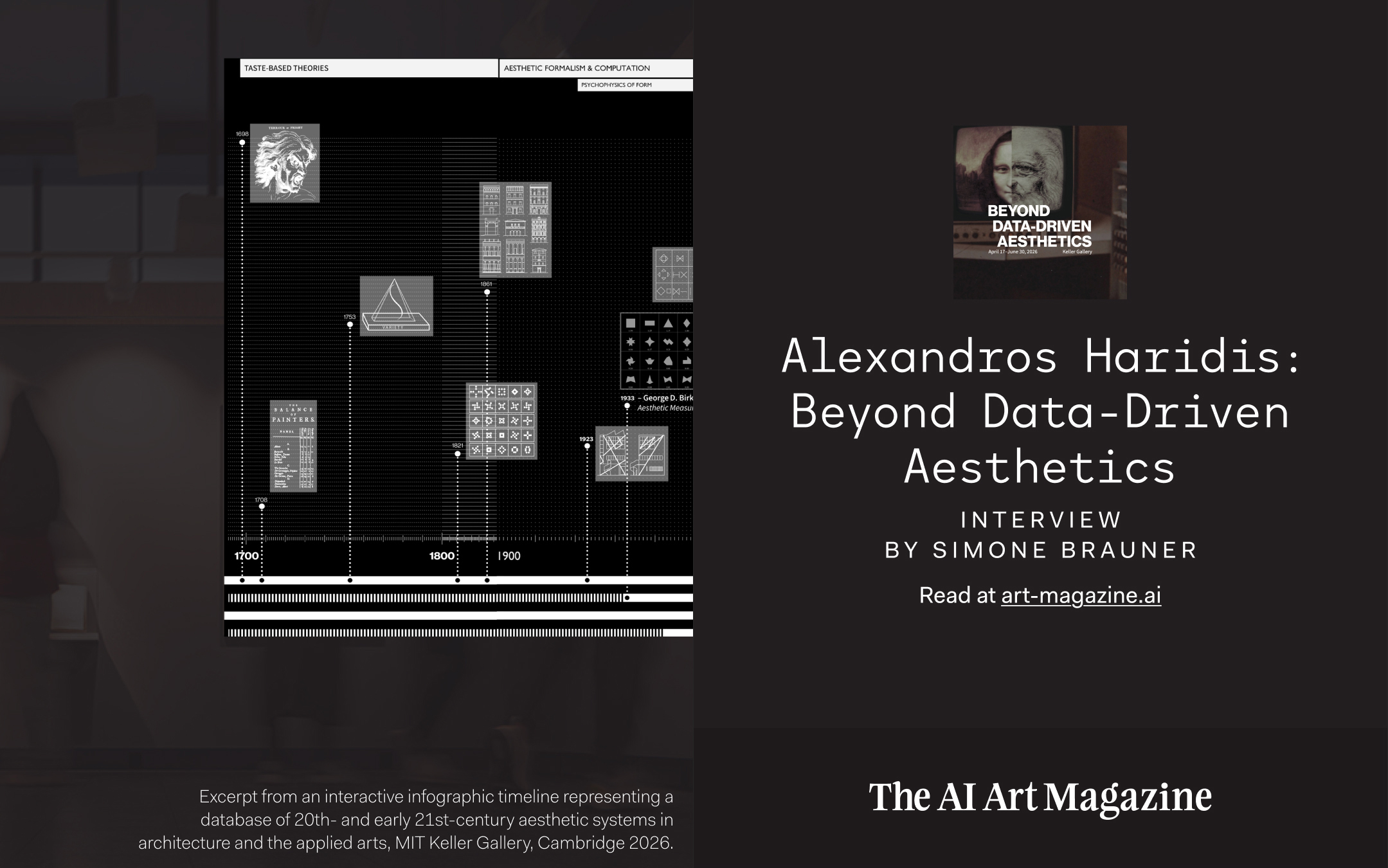
The exhibition draws from a much larger database of aesthetic systems going back to the 17th and 18th centuries. Extending this chronological index and making it available to other researchers and scholars is one of the directions I will continue to focus on. At the same time, I’m increasingly interested in how these ideas can move into broader applications related to the built environment. In particular, I am interested in how research connected to “Beyond Data-Driven Aesthetics” can help designers and engineers better understand how computation—whether rule-based or data-driven—can inform us about what contributes positively to human experience in relation to the spaces and objects that people inhabit and use.
Finally, a direction I continue to explore is the methodological role of design itself as an interpretive device. Through techniques such as software reconstruction, visualization, and physical making, design becomes not merely a way of presenting research but a way of conducting and interpreting it. The exhibition uses design to translate opaque computational systems into more legible, tangible, and experiential artifacts. More broadly, this opens questions not only about mechanizing “beauty” or “taste” (the traditional preoccupation of aesthetic formalism in the 20th century), but also about how traditional forms of research scholarship and communication may evolve through spatial, visual, and public-facing formats. In that sense, I hope the platform will not simply expand our understanding of aesthetics but also broaden the ways in which computational research itself can be expanded, communicated, and experienced through design.