News
Talk – IntCDC Constructive Conversations (November 2026)
November 19, 2026
IntCDC Constructive Conversations Lecture Series
University of Stuttgart
Department for Computing in Architecture
Cluster of Excellence, Integrative Computational Design and Construction
for Transformative Architecture (IntCDC)
4 – 6 p.m. (CET)
University of Stuttgart, K I, Lecture Hall, M 11.11
Keplerstr. 11, 70174 Stuttgart
& online
IntCDC Constructive Conversations
The Cluster’s expert guest lecture series “IntCDC Constructive Conversations” ensures a close interaction with the larger research community by hosting renowned national and international scientists, including IntCDC Visiting Professors, and industry experts to present their insights on current topics and challenges in the field of IntCDC.
The lecture series is open to the public.
Title of Talk:
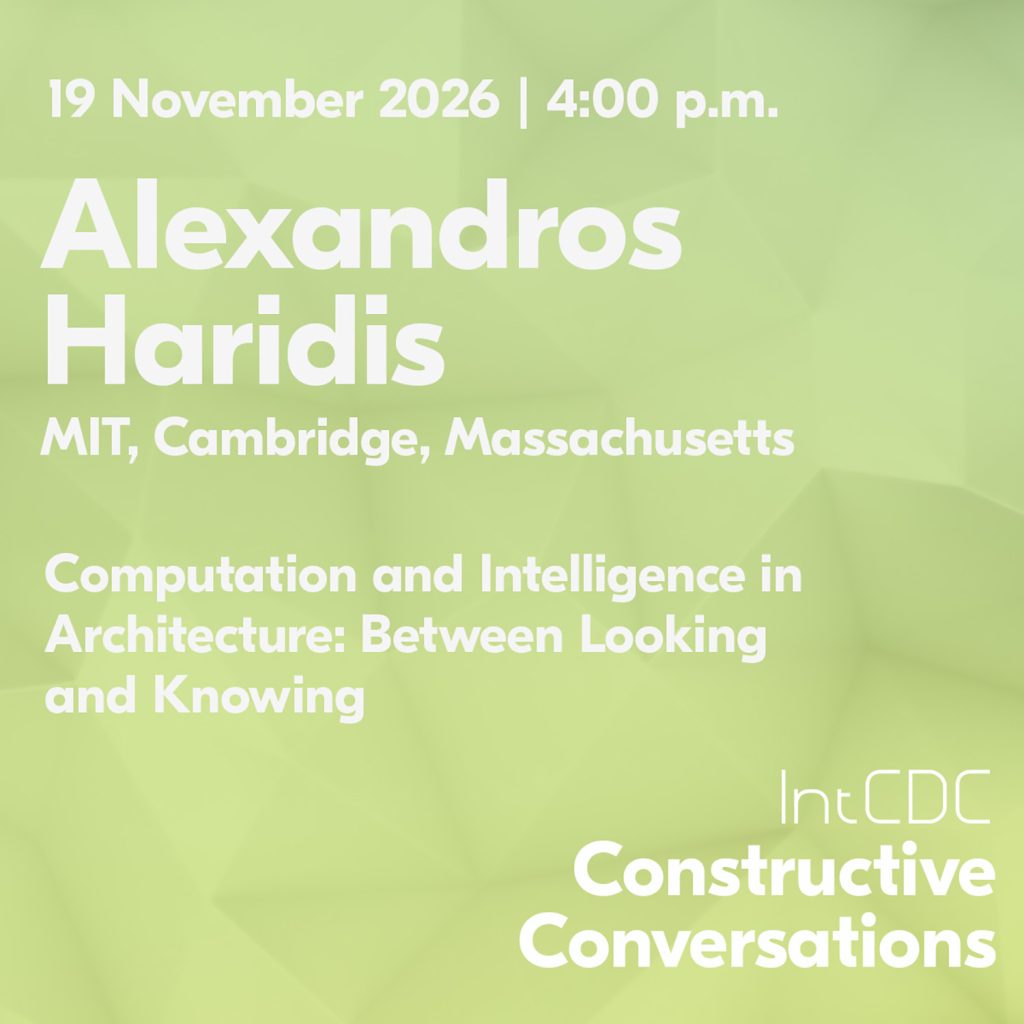
Computation and Intelligence in Architecture: Between Looking and Knowing
by Alexandros Haridis
Computing and AI systems now generate and rank architecture, art, and design. Judgments that once belonged to designers are being redistributed to software vendors, to models whose inner criteria are rarely visible, and to curators of training data. It is essential to develop methods for navigating and steering the solution spaces these systems generate, while making the judgments embedded in their computations visible and explainable. This talk presents projects that explore some of the tensions and possibilities emerging at this disciplinary nexus. How might we trace a vision algorithm’s decisions back to the parts and features of an object that shaped them? What theory-informed framings of human seeing and interpretation might help explain the ranking mechanisms that guide generative AI, if at all? Examples from research on shape grammars, reconstructions of twentieth- and twenty-first-century creation–evaluation systems presented in Beyond Data-Driven Aesthetics, and machine learning benchmarks in architecture are considered in relation to human, open-ended looking. Can architecture and design keep their many ways of looking and judging while embracing innovation in computing and human-AI collaboration?